NOT JUST A FLASH IN THE PAN
After 12,000 km of hard riding to the East Coast and north to James Bay,
Yamaha's Seca keeps its polish
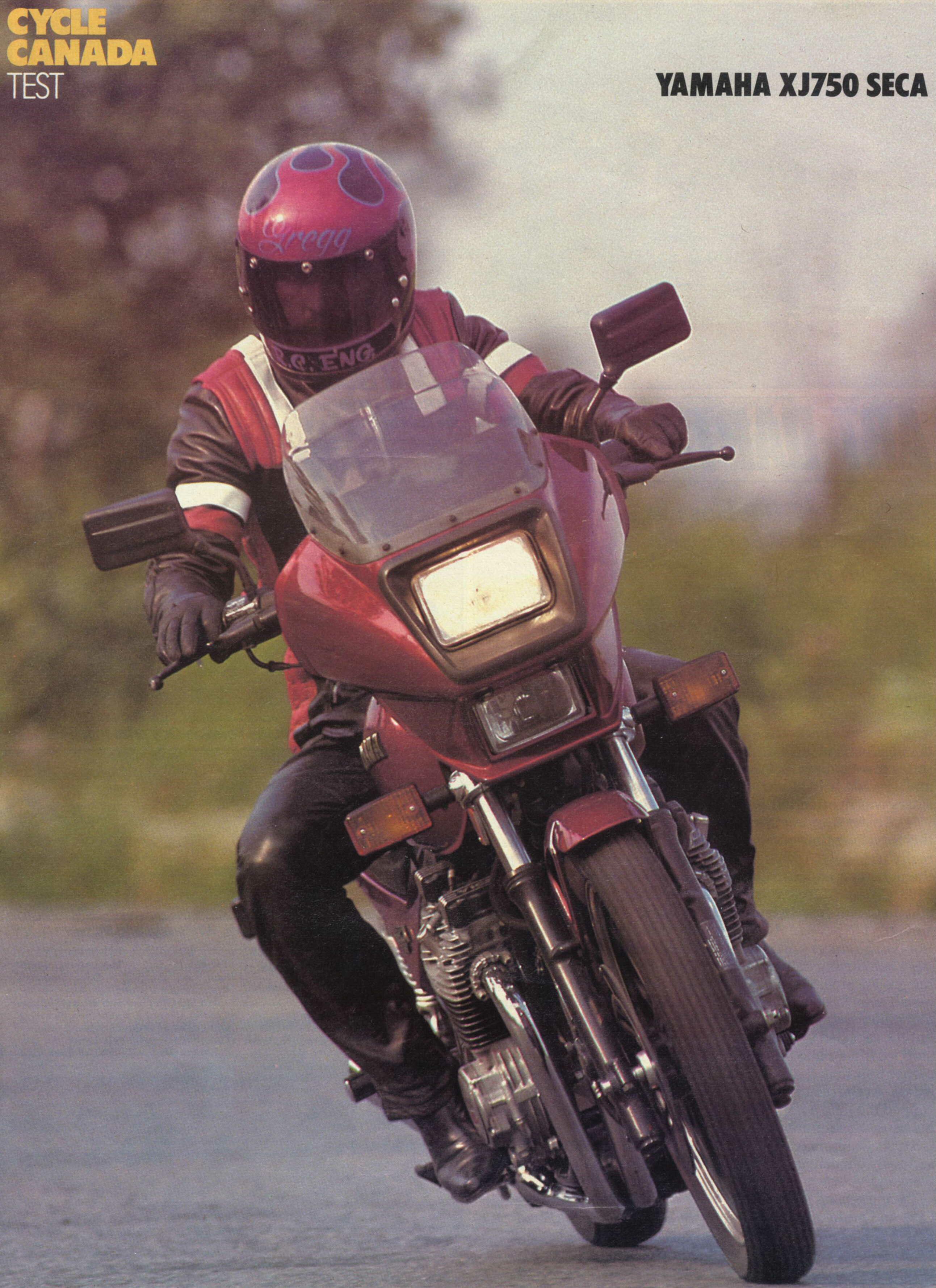
You can't help but notice the Yamaha Seca 750. Its unique, integrated styling and
modern technology set it apart from the crowd. But what's below the glitzy
surface? How will the motorcycle stand up to long, hard use? Will the
computerized instruments go crystals up after exposure to the elements? And
what about the engine? Twelve-second quarter-mile times require plenty
of horsepower, and the more power, the shorter the fuse.
We conducted a 12,000 km long-term test of the Seca, touring and tearing under
every imaginable weather condition, two-up and solo. Now we have the answers.
The 750 Seca is durable. Cosmetically, our test bike dould pass for new after a
good cleaning. The paintwork is still Brilliant Red as Yamaha calls it, protected by
a thick coat of clear lacquer. Neither exposure to the sun nor a tankbag fitted for
a Maritime tour has dulled the finish. Windblown debris from truck wake on the
highway failed to scratch or nick any part of the motorcycle.
The engine has been as reliable as a hammer. There are no oil leaks anywhere,
just minor weepage where the driveshaft housing joins the differential.
Oil consumption under normal riding conditions is so small as to be insignificant.
When pushed hard -- 1,100 km in 12 hours, two-up with luggage -- the level
would drop slightly, reassuring the rider that valve guides and piston rings were
receiving adequate lubrication for the job asked of them. Consumption returned to
normal when riding did.
The engine is unchanged from the 1981 model with the exception of black paint
on the camcover and cylinder block. It may be there for looks alone, to distinguish
the bike from the older version, or to help cooling. It's worth noting that unlike the
Canadian Seca 650 and the European Seca 750, this Seca 750 does not come
with an oil cooler. Under conditioris of high speed and load, an oil cooler would
make life easier for the 3.5 litres of engine oil. Yamaha recommends that the oil
be changed every 3,000 kmand the filter every 6,000 km. Do it more often if you
run the bike hard.
Performance has not declined with the passing kilometres. It has the same horse-
power and torque as when it was first broken in. The narrow, jackshaft-equipped
four- cylinder engine is as smooth as ever and still feels tight and solid despite
hard use. The engine inspires confidence on a long run.
Power is biased toward the upper end of the rev range. There is a noticeable
surge in the powerband at 6,000 rpms the engine pulls quickly to red- line at
9,500 rpm. That's not surprising for a double over- head camshaft design, but for
a two-valves-per-cylinder engine it is a bit soft in the mid- range. The Seca lacks
the roll- on pnnch of the Kawasaki KZ750 which uses a similar engine design.
Idealiy, the power surge would come at lower revs and the final-drive gearing
would be taller, to drop engine speed while cruising on the highway.
Transmission and clutch have proved bulletproof. There is some notchiness in
finding neutral for which the shift linkage was suspect, but the stickiness was
found to be internal. The clutch never slips under immoderate street use and has
a smooth, easily controlled engagement point. The Seca 750 handled well when
new
and feels unchanged after 12,000 km. We mounted set of saddlebags and a
topbox for the touring portion of the test and found the additions seriously
affected handling. The pendulous mass of the loaded topbox lightened the front
end to the detriment of stability when cornering or on straights.
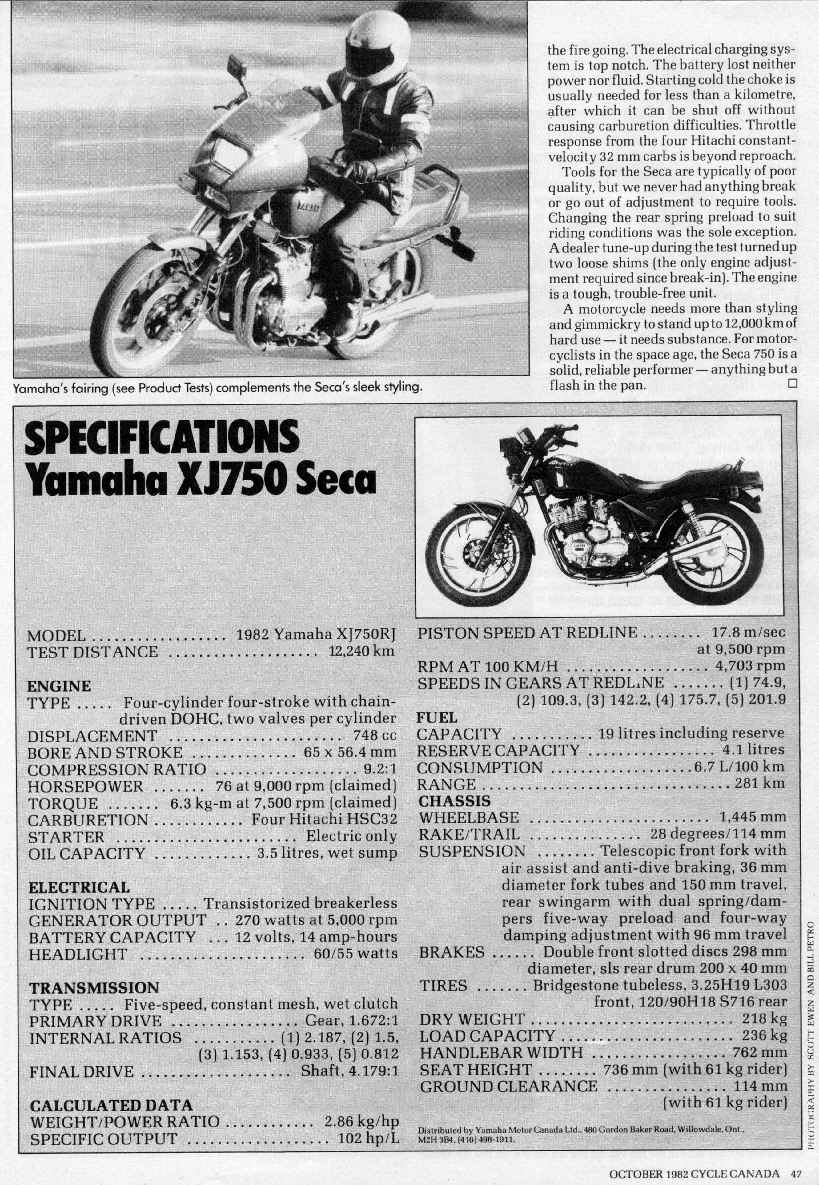
With a dry weight of 218 kg and a wheel- base of 1,445 mm, the Seca is lighter
than some of its Glass rivals, most notably the Suzuki GS750 and Honda's Sabre
and CB750F, but is close to Kawasaki's KZ750.
The Seca offers a less than perfect ride over expansion joints on the highway and
a choppy feeling on rougher roads. But it's nimble in turns and on twisting back-
roads. The choppiness comes from the inability of the suspension to control fully
the unsprung weight of front and rear wheel assemblies.
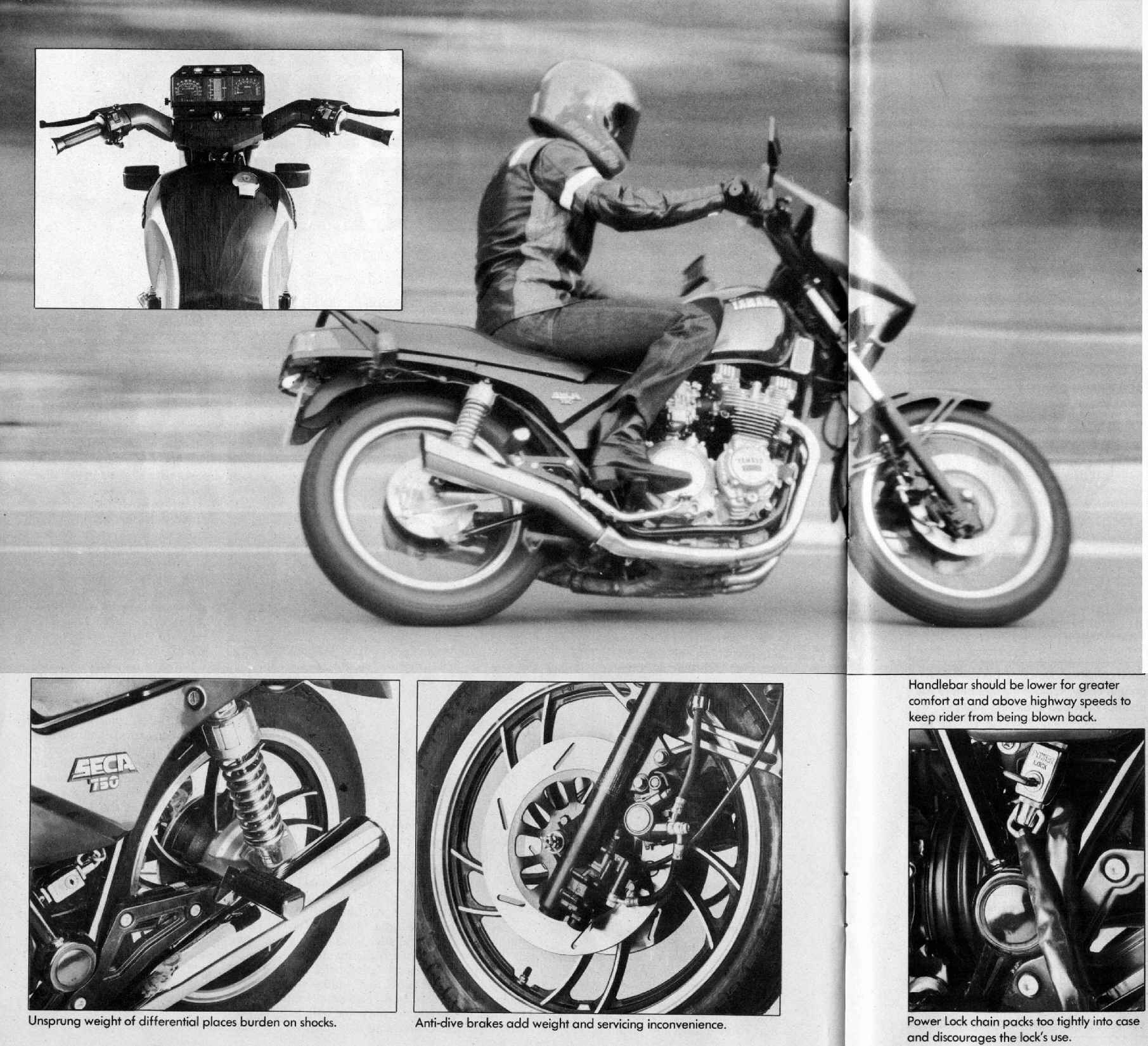
There's a considerable weight around the front axle -- two large discs, calipers
and the anti-dive mechanism. At the rear, a driveshaft and a differential housing
with bevel gears add to the burden on the adjustable shocks. Still, ride quality
was acceptable and the jacking effect that driveshafts traditionally have on motor-
cycles minimal.
The chassis is a strong one. The double- cradle steel frame is heavily braced
around the steering head and triangulated behind the engine. The downtubes
below the seat and the cradle tubes coming up behind the engine meet in welded
steel circles for the swingarm/driveshaft housing pivot.
The Seca won't flex when ridden hard thanks to the frame design and the front
fork assembly. Sturdy 36 mm fork tubes are firmly held with six bolts on the triple
clamps.
While the Seca doesn't have a flexy frame, it does have a weight-distribution
problem. Weight bias for the 218 kg motor- cycle is 44 per dent front and 56 per
cent rear. That's 3 per cent less on the front end than either the Kawasaki KZ750,
Honda CB750F or the Suzuki GS750EX. The stock tires aggravate the light front
end. For a sporting 750 cc motorcycle, the tires are too narrow and the rubber
compound too hard. When pushed hard in corners, marginal traction with stock
rubber often unnerves the rider, forcing him to back off the pace or risk losing the
front end. We would gladly trade off some tire life for better traction, especially at
the front which after 12,000 km shows little sign of wear. The rear tire, though, is
just about finished.
There is no question that the anti-dive system works, but there is a price to be
paid besides the unsprung weight and complication. It now is a chore to bleed the
brake system. Four nipples have to be bled and the cable-operated master
cylinder hidden below the top triple clamp makes it all but impossible to see fluid
level or anything else. We have no complaints about brake feel or operation but
then we didn't have any for the Seca 650 either, which had no anti-dive.
Computerized instrument panels are common now but when it first arrived last
year, the Seca's instruments stunned observers. It remains unchanged for 1982.
The central piece is a liquid crystal display that monitors seven separate functions
and graphically indicates the fuel level. Sidestand, brake-fluid level, engine-oil
level, battery-fluid level, head- light, taillight and fuel-warning LCDs light up in
sequence within two seconds of the engines start, as the computer scans each
electrical pickup for abnormal readings.
A check button will make the computer cycle through the system but it isn't
necessary as any malfunction automatically starts the warning light flashing while
the appropriate LCD is illuminated. The flashing warning light can be a distraction,
so an override button can either stop the light flashing on the first push or cancel
it with another.
The Cable-operated speedometer and electric tachometer suffered from the fit-
ting of the LCD display. Both instruments should have bigger faces but the
speedometer especially seems squeezed; too many little white Lines make quick
reading of the speed difficult.
Riders' reactions to the computer sys- tem varied. Some didn't mind it or worry
about possible replacement (at a cost of approximately $550). Others found it
overly complex and fragile -- more flash than function. Our test bike suffered no
problems with the instruments despite powerwashings and plenty of exposure to
the elements.
A Yamaha dealer we talked with has had no Seca 750 in for instrument or
computer problems either so it seems that it is durable, but since the bike has
only been on the market for two years, extended lifespan is unknown.
The computer system comes with restrictions and warnings for the protection of
the delicate assembly. Wattage of light bulbs cannot be changed, extra electric
accessories cannot be added to the computerized monitor system, the instrument
panel must not be subject to splashing or steam from underneath (don't ford
rivers with a hot engine), the display panel must not be pressed hard or given any
shock and magnets or magnetized objects must not be put near the display
panel.
Despite the trick -- some would say ugly -- appearance of the headlight and small
spotlight, lighting is inferior to a good round headlight like the Seca 650's. In the
country on moonless nights, the beam from the rectangular headlight lacks
definition and penetrating power. The spotlight helps to illuminate distant
reflective road signs and the like but otherwise is ineffective. The spot is clear this
year instead of amber as in 1981 because of some Canadian regional lighting
regulations. The wrap-around taillight is attractive, bright and clearly visible from
the side.
Self-canceling turn signals are bright and work well. They can be cancelled by
hand at any time or will self cancel after the motorcycle has traveled 150metres or
for 10 seconds, whichever is greater. With the exception of the high/low beam
switch, the controls are easy to operate and logically placed. The high/low switch
is too far from the grip for easy manipulation and needs conscious thought to
operate. Operation of the spotlight switch requires moving the right hand from a
secure grip on the bar.
The mirrors are among the best we have seen. One rider didn't like the
rectangular shape but for most of the others shape was fine; the mirrors didn't
blur and offered a wider range of visibility to the rear than conventional round
mirrors. Seating position and comfort are good but not exceptional. The seat feels
as stepped as it looks but for most riders it was comfortable even after a long
ride. It curves down below the rider and spreads his weight over a wider contact
area than a flatter seat would. The foot pegs are low enough that tall riders didn't
feel that they were sitting on their feet. Knees can tuck in close to the engine
below the narrow rear section of the fuel tank for warmth on a cool night.
The handlebar didn't make many friends, although because it is a real bar and
not a pair of expensive forgings the owner can easily switch to a preferred shape.
The stock bar is too wide and high and places the rider's torso directly into the
wind.
Passengers will like the Seca if they are of relatively short stature. The pegs are
high in relation to the seat and require too much knee bending for taller riders to
be comfortable.
The Seca 750 rates highly as a safe motorcycle. Brakes are good, with a rear
drum for instant response in the rain and discs that are easily controlled with a
firm hand. Modulation of both brakes is excel- lent and accidental wheel locking
never occurred. The horn is one of the loudest in motorcycling, a welcome sound
after too many almost inaudible little horns. Tail and brake lights as well as turn
signals are bright enough to alert near Sightless automobile drivers.
Few riders found any vibration worth commenting on and then it was only the
mildest sensation in the handgrips and footpegs at high engine speed. It is no
worse than any parallel four-cylinder motorcycle and better than many. There
were no squeaks or rattles from any part of the motorcycle.
Not once did the Seca fail to start on the first try. Despite sitting out in a cold,
hard Atlantic rain overnight, a flick of the choke and a push on the starter button
got
the fire going. The electrical charging sys- tem is top notch. The battery lost
neither power nor fluid. Starting cold the choke is usually needed for less than a
kilometre, .after which it can be shut off without causing carburation difficulties.
Throttle response from the four Hitachi constant- velocity 32 mm carbs is beyond
reproach.
Tools for the Seca are typically of poor quality, but we never had anything break
or go out of adjustment to require tools. changing the rear spring preload to suit
riding conditions was the sole exception. A dealer tune-up during the test turned
up two loose shims (the only engine adjustment required since break-in. The
engine is a tough, trouble-free unit.
A motorcycle needs more than styling and gimmickry to stand up to 12,000 km of
hard use -- it needs substance. For motor- cyclists in the space age, the Seca
750 is a solid, reliable performer -- anything but a flash in the pan.