
Carburetor Synchronization
By Doug Jenks

The purpose of carburetor synchronization is to adjust all the carburetors so they have the same air flow through all of the carburetors. If the carburetors are out of synchronization, they will receive different amounts of fuel and air. This will allow each cylinder to have different loads which can overheat the dominate cylinder(s) causing different colors to appear on the header pipes. Carburetor synchronization means adjusting all of the slides or butterflies to the same height at all times.

Most motorcycles have one carburetor that has no adjustment while the others can be adjusted. The non adjustable carburetor is used as a point where all others are adjusted too. If you are working on a 4 cylinder engine and carburetor number 3 does not have an adjustment, you would adjust numbers 1, 2, and 4 to whatever reading number 3 is. Some motorcycles use three screws (most Yamahas such as the XJ and FZ series). The left screw adjusts cylinders 1&2 while the right screw adjusts 3&4. The center screw adjust 1&2 to 3&4. You must decide what type of adjustment set-up you have.

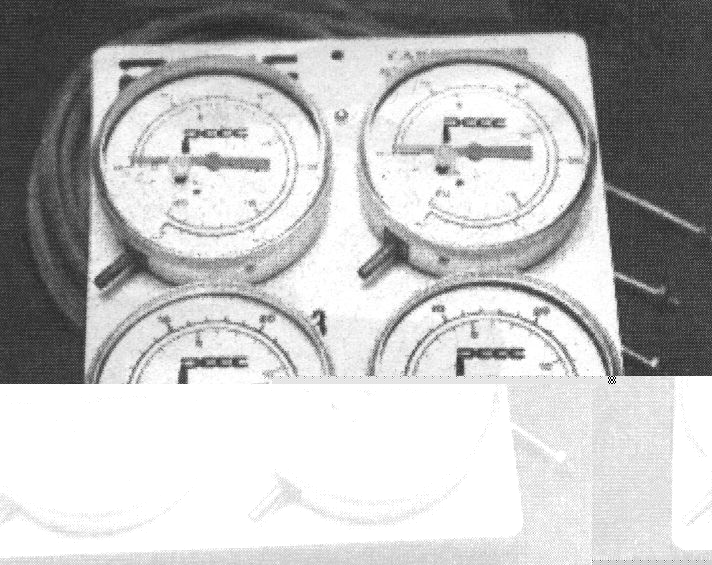
The special tools that are needed are vacuum gauges, auxiliary fuel tank (I use a plastic fuel tank from a Tecumseh lawnmower), and an adjustment screwdriver. There are two types of vacuum gauges that most types of mechanics use. One type uses four individual dial gauges, fig 1 while the other uses mercury in a set of glass tubes, fig 2. Most motorcyclist will find the mercury gauges will work good considering their low price and ease of use. Mercury type gauges do not need to be synchronized with each other as do the dial gauges. The disadvantage of mercury is it is very poisonous and there is the possibility it can be sucked into the engine if care is not taken. Mercury gauges must be kept upright at all times to stop the mercury from spilling out.


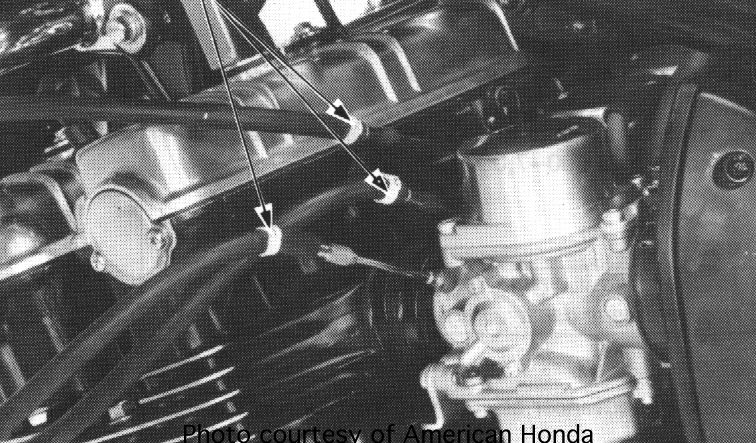
Begin synchronizing by first adjusting the valves and making sure the engine rings, valves, etc are sealing properly. Synchronization cannot be done if these parts are worn or out of adjustment. Start and warm up the engine and turn it off after it has been warmed up. Remove the plugs and install the adapters, fig 3, in the intake manifold. Put the hoses on the adapter making sure that the hose on the left goes to the number 1 cylinder (left cylinder) and work from left to right. Restart the engine and check the settings. On mercury gauges they are marked in 2.0cm increments and this is the allowable limit. If all of the cylinders are within one line of each other the carburetors do not need to be adjusted. Even though the limit is usually 2.0cm set them all exactly the same for peak performance.


Caution- Yamahas that have the Yamaha Induction Control System (YICS) cannot be synchronized without a special tool to seal the intakes tracts from each other. If this tool is not used, the carburetors cannot be synchronized. The Yamaha part number for the tool is 90890-04068. The XJ series of motorcycles is one type that has the YICS system.

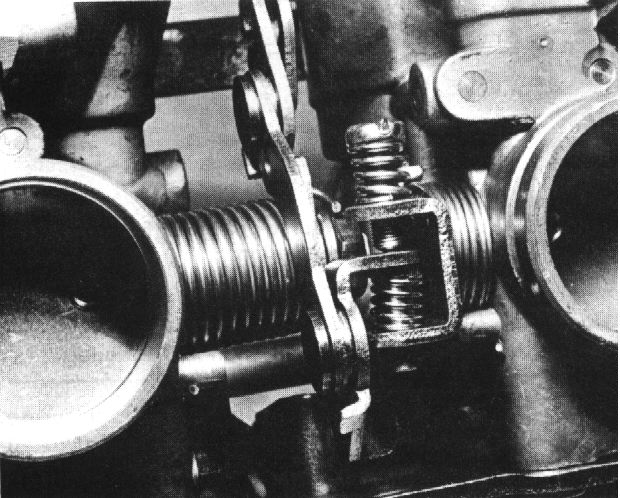
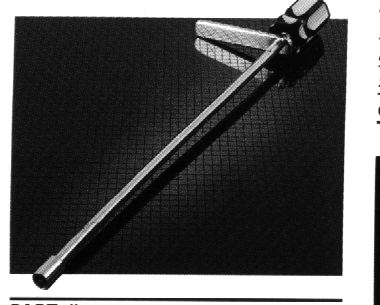
To make adjustments remove the fuel tank. If your bike has a vacuum operated petcock, plug the line so it will not leak. Most constant velocity carburetors are adjusted by a screw located outside the carburetor body fig 4. Use a special screwdriver, fig 5, to make adjustments to the carburetors. Rotating the screw counterclockwise opens the throttle and lowers the vacuum. Rotating the screw clockwise closes the throttle and raises the vacuum. Adjust all of the carburetors to the non-adjustable carburetor (if your bike has this type of carburetor). If your bike has the other type of adjustment system, adjust cylinders 1&2 equal using the left adjustment screw. Adjust cylinders 3&4 equal using the right adjusting screw. Finally adjust the center screw until all the cylinders are equal. After each adjustment, blip the throttle slightly to seat the linkages. Do not rev the engine past 4000 RPM's.


Once all of the carburetors are adjusted install all the parts that were removed. Your bike should run cleaner and smoother after the carburetors have been synchronized.

See your local motorcycle dealer for any special tools that are needed. A set of mercury type gauges can be bought for between $41 to $72 depending on the quality. The special screwdriver can be bought for $19.95.


Date Last Updated 2-2-98

For private non profit use only. All rights reserved.

Please contact me for use of this material.