Maxim-X Thermostat Replacement


As with any other liquid-cooled vehicle, it's sometimes necessary to replace the Maxim-X thermostat. When that time comes, Maxim-X owners usually start by approaching Yamaha for a replacement, after which the discouraging reality becomes apparent and another solution becomes necessary. That's the point at which this particular information becomes helpful.


History
Maxim-X owners like myself have looked long and hard for an alternative to the original Maxim-X thermostat. While it may still be available directly from Yamaha (Part# 3GM-12410-00-00), the part is expensive (upwards of CAD$40 after taxes) and illusive, sometimes being back-ordered for as long as a full year. The unrealistic cost and lack of availability of the thermostat are what led to the quest for a viable replacement.

Credit where credit is due: Being one who drives his motorcycle daily, I wasn't willing to take it apart just to get my hands on the thermostat for comparison to others. There were simply too many things that could go wrong which threatened to leave me stranded. To circumvent that problem, I posted an inquiry on the XJ Owners' Mailing List hoping that someone would be able to tell me where I could buy a new thermostat for a reasonable price or where I might find something compatible. Tragically, the concensus was the same - there was simply no other choice than to buy a new thermostat directly from Yamaha. I had almost surrendered to that belief when a fellow XJer from the Netherlands, a fantastically helpful guy named Geurt Groen, contacted me by e-mail saying that he had an extra thermostat for the X which he was willing to part with for just the cost of shipping. Naturally, I accepted and only a short time later, Geurt's Maxim-X thermostat arrived at my door in Canada. I suddenly had exactly what I needed to begin my search for the perfect replacement, thanks to a generous friend halfway across the globe.


Identification of Original
Since a new thermostat would have to fit into the same housing on the Maxim-X, I began by noting the appearance, size and geometry of the original Maxim-X thermostat... which I could now measure and photograph, thanks to my Europian friend, Geurt.
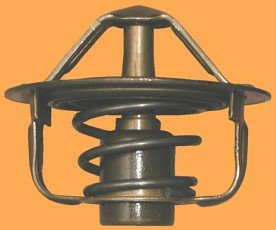
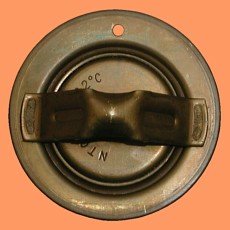
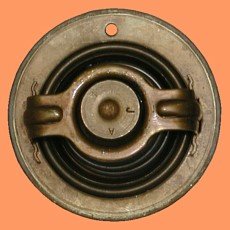
Original Thermostat - Profile Original Thermostat - Top Original Thermostat - Bottom

Distinctive Features
In profile view, I noted that it was important that the measure of the vertical limits above and below the central hub must be equal or less for a replacement thermostat (ie. the top and bottom halves of the newer thermostat had to be shorter). A taller thermostat might interfere with the Maxim-X thermostat housing, as would one whose depth was greater as well. Similarly, it was important that neither the top nor bottom widths of a replacement exceed that of the original thermostat. A wider point anywhere along its profile could also interfere with the Maxim-X thermostat housing.

In plan view, I noted the size of the original thermostat aperture and also that the aperture was offset slightly from centre, toward the bottom of the pictures above. The aperture size, in part, would define how much coolant would pass through an open thermostat so finding a replacement with very nearly the same diameter of aperture was of paramount importance. I also noted the position of the vent hole relative to the aperture in the unlikely event that housing restrictions forced installation of a new thermostat with the vent in an unfavourable position, one that might trap air below the thermostat.

Measurement of Original
After noting all the relevant features, it was time to measure the original thermostat. Armed with a digital vernier caliper, I measured and re-measured every conceivable dimension of consequence until I was satisfied that the measurements were correct. It wasn't obvious until I began to measure, but thermostats aren't constructed as precisely as you might think. Almost nothing is square and measurements on one side vary slightly from what should be symmetrical measurements on the opposite side. To complicate matters, the awkward shape wasn't always conduscive to using a caliper. Simply finding reliable maximum and average measurements was difficult and took a fair amount of time. Nevertheless, it had to be done.

Searching for Replacement
With the original thermostat, a caliper, notepad and measurements in-hand, I visited my local automotive parts supplier, Canadian Tire. It was truly difficult to decide where to begin when confronted with such a vast assortment of strikingly similar thermostats, so I decided on a systematic approach. I pulled up a chair and made myself comfortable mid-aisle for the better part of two hours. Examining thermostats which were still in their packaging also made measuring difficult but relative dimensions seemed to be more important anyways. After several comparisons, it started to become apparent that many of the thermostats had standard outside diameters and that aperture diameters essentially came in two sizes - big and small - with only slight variations. I learned that REGULAR FLOW thermostats had the smaller diameter apertures and that HIGH FLOW thermostats had the larger diamater apertures... which conveniently matched the aperture diamater of the original Maxim-X thermostat. This new information made it possible to narrow the search considerably, by inspecting only HIGH FLOW thermostats, all of which appeared to have equal aperture diameters. The search eventually ended with a single HIGH FLOW thermostat, with all the right dimensions, a MOTORAD 2040-180, Canadian Tire Part# 14-4380-8.
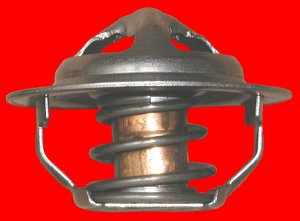
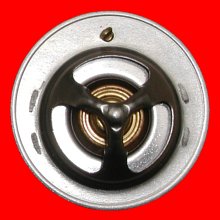
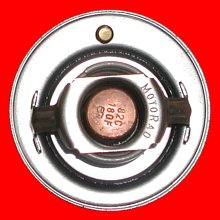
New Thermostat - Profile New Thermostat - Top New Thermostat - Bottom

It wasn't easy. I had made countless calls to suppliers, both in Canada and the United States. I tried motorcycle parts suppliers, marine parts suppliers, automotive parts suppliers and I even contacted several vintage cooling system specialists that claimed they could solve any cooling system problem for me. Yeah right. After speaking to and involving countless people in my quest for a replacement thermostat for the Maxim-X, no one had anything helpful to say and all roads led back to Yamaha... until I took matters into my own hands.

At this point, I was fairly convinced that I had found a suitable replacement for the original Maxim-X thermostat. Physically, the dimensions and characteristics were perfect so I thought it important to take the time to record dimensions before continuing to operational testing.


Comparing Dimensions
When I found the Motorad 2040-180, I was fairly certain I had found the perfect replacement thermostat for the original Yamaha 3GM-12410-00-00. My previous comparisons were made with the new thermostat still inside its packaging. Now having bought the new thermostat, however, I was able to remove it from its packaging to take some more accurate measurements for a final comparison and documentation.

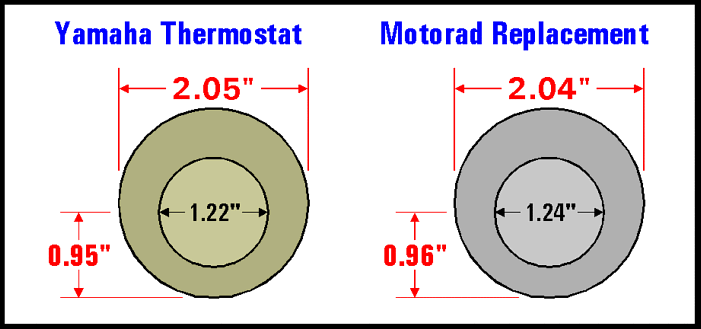
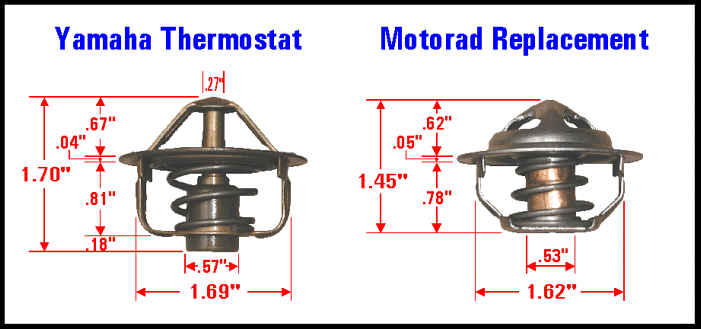
As expected, all dimensions of the new thermostat seemed to work. The outside diameter was only 0.01" smaller than the original, which would easily be absorbed by the rubber ring gasket. The aperture was only 0.02" larger than the original so coolant flow wouldn't be restricted if valve sweep was similar. Both the top and bottom sections of the new thermostat extended less than the original (not as tall & not as deep) and all critical widths were also smaller, meaning the new thermostat was physically capable of replacing the original, as expected.

All conceivable measurements of both the original and the replacement thermostats were recorded as shown in the following plan view and profile view images:


Although the original Yamaha thermostat and the replacement Motorad thermostat aren't very similar in appearance, the magnitude of critical physical dimensions are very comparable, making the Motorad thermostat the perfect alternative, physically. The only remaining question was whether the new thermostat would behave like the original one under operating temperatures. Some operational testing still had to be done, just to be certain.

Testing Thermostat Operation
Having found a physically suitable replacement thermostat for the original Yamaha part, it was still necessary to verify that the new thermostat would operate in the same way as the old one. Although both thermostats were rated at 180°F (82°C), it was unsubstantiated whether they would truly open at the same time, whether they would open at the same rate or whether they would produce the same flow characteristics. If the new thermostat opened more suddenly than the old one, it could cause a temperature shock situation that might conceivably damage the engine, perhaps even crack the head or block. If the new thermostat opened too slowly, it might result in serious over-heating problems in summer stop & go traffic. And, if the flow rate through the new thermostat wasn't comparable to the old thermostat, it could pose cooling problems during extended periods of extreme engine heating (like 1 hour at WOT from Stoufville to Waterdown with smouldering saddle bags). Each of those aspects of thermostat function had to be compared before it became conclusive that the Motorad thermostat was a suitable replacement for the original Yamaha part.

For testing, both the original and the replacement thermostats were submerged in a container of cooking oil which was slowly heated to typical operating temperatures and beyond. Both thermostats began to open at precisely the same time (roughly the rated temperature) and also opened to the very same extent. The valves also closed at the same rate as the oil cooled down again. At that point, it was conclusive - the Motorad thermostat was perfect in every way as a replacement for the original Yamaha part.


Sourcing Replacement Thermostat

[Addendum - March 30, 2006: I wanted to keep an extra thermostat on stock so I returned to Canadian Tire to buy another Motorad 2040-180 but found that they were no longer on the shelf. When I inquired with the parts department, they told me that the last Motorad 2040-180 thermostat they had sold was almost a year earlier, back in May of 2005, which happened to be when I bought the one that led to this write up. I was told that they no longer stocked it but that it was still a listed part and could be easily ordered in. With some further inquiries I found that the same Motorad 2040-180 thermostat is available at Part Source because Motorad is apparently their brand name.]

[Addendum - April 7, 2006: I was previously unable to source a replacement gasket for the Maxim-X thermostat without buying the entire thermostat assembly from Yamaha for upwards of CAD$40. Recently however, I was able to find what appears to be a viable replacement gasket at Part Source. Although the gasket has a slightly larger diameter, a ROL W08361-001 "Water Outlet Gasket" from Part Source will apparently work (although I haven't officially verified it yet). Some other part numbers that will identify the same gasket from other suppliers are CTC 17-4279-6, FP-35001 and VICT C24117TC.]

The quest to find a suitable replacement for the original Maxim-X thermostat eventually led to a Canadian Tire store which carried the appropriate Motorad replacement. That replacement may be suitable and easily sourced now and in Canada, but the information does nothing to help other Maxim-X owners around the world and, for that matter, Canadian Tire may eventually stop carrying the Motorad line. For those reasons and more, I thought it appropriate to provide a list of vehicles which, according to the Canadian Tire cross reference table, share the same thermostat. In theory, if you can't find or don't have access to the Motorad 2040-180 (CTC Part# 14-4380-8),then you should be able to use the cross reference provided here as a guide to source a similar thermostat through your local automotive parts supplier. If all else fails, the details provided in the Dimensions section should help you converge on a suitable alternative thermostat.

Each of the following vehicles are listed as using the Motorad 2040-180 (CTC Part# 14-4380-8) thermostat:

Chrysler, Dodge & Plymouth Passenger Cars
4 Cylinder
6 Cylinder
8 Cylinder
1.5 L
1979-92
••••
1.6 L
1978-90 except Charger
••••
1.8 L
1989-92 ΉCode B,D,T
••••
2.0 L
1986
••••
2.0 L
1987-94 except 1993 Laser
••••
2.4 L
1992 Code ΉW
••••
2.6 L
1981-85
••••
••
3.0 L
1989-95
••

Eagle Passenger Cars
4 Cylinder
6 Cylinder
8 Cylinder
1.5 L
1988-92
••••
1.6 L
1989-90
••••
1.8 L
1992
••••
2.0 L
1989-90 except Talon
••••
2.0 L
1991-92 except DOHC models
••••
2.0 L
1993-94 DOHC models
••••
2.4 L
1992
••••

Ford, Lincoln & Mercury Passenger Cars
4 Cylinder
6 Cylinder
8 Cylinder
1.3 L
1989-96
••••

Honda Passenger Cars
4 Cylinder
6 Cylinder
8 Cylinder
ALL
1975-89 Accord
ALL
1977-83 Civic
ALL
1979-91 Prelude

Hyundai Passenger Cars
4 Cylinder
6 Cylinder
8 Cylinder
1.6 L
1992-95 Elantra
••••
1.8 L
1993-95
••••
ALL
1986-94 Excel
ALL
1984-87 Pony
ALL
1991-93 Scoupe
ALL
1989-98 Sonata
ALL
1985-87 Stellar

Mazda Passenger Cars
4 Cylinder
6 Cylinder
8 Cylinder
ALL
1981-85 GLC, 323 & Protegι
ALL
1981-85 626

Toyota Passenger Cars
4 Cylinder
6 Cylinder
8 Cylinder
ALL
1982-85 Celica
ALL
1978-92 Cressida
ALL
1981-83 Starlet
ALL
1979-92 Supra

Chevrolet & GMC Trucks
4 Cylinder
6 Cylinder
8 Cylinder
1.6 L
1989-98 Sunrunner & Tracker

Chrysler, Dodge & Plymouth Trucks
4 Cylinder
6 Cylinder
8 Cylinder
2.0 L
1979-88
••••
2.4 L
1990-93
••••
2.6 L
1983-89
••••

Ford Trucks
4 Cylinder
6 Cylinder
8 Cylinder
2.0 L
1979-82 Ranger
••••
2.9 L
1986-90 Bronco II & Explorer
••••
••
2.9 L
1986-90 Ranger
••

Mazda Pickups
4 Cylinder
6 Cylinder
8 Cylinder
2.0 L
1981-87
••••

Suzuki Trucks
4 Cylinder
6 Cylinder
8 Cylinder
ALL
1986-98 Samurai & Sidekick

Toyota Trucks
4 Cylinder
6 Cylinder
8 Cylinder
2.2 L
1977-80 Pickups & 4Runner
••••
2.4 L
1981-96 except Tacoma, Diesel & Turbo
••••
2.4 L
1986-87 Turbo
••••

Footnote Key
Ή
Prior to 1981 the Code was the 5th character of the V.I.N.
1981-Present the Code was the 8th character of the V.I.N.

Disclaimer
I've tried to be as accurate as possible when compiling this list but there's always room for error. I've basically listed all the vehicles which were shown to use the Motorad 2040-180 (CTC Part# 14-4380-8) in the Canadian Tire cross reference table which itself might not be completely accurate. Although I was very careful to note things correctly, I too might have introduced an error or two. The odds are in favour of accuracy but just to be certain that you're sourcing the correct replacement thermostat, it would be wise to go armed with the Dimensions which I, myself, measured and recorded very accurately.

Maxim-X Thermostat Replacement Notes


Notes
These are some additional notes of interest in regard to the Maxim-X thermostat and related repairs.

•    FAIL OPEN - LIKELY
Although the original Yamaha thermostat for the Maxim-X isn't a fail-open unit, that's exactly what it tends to do. I haven't heard from any Maxim-X owners or service technicians that the original thermostat will fail shut and cause over heating. However, I have heard from many people that the typical failure mode is in the open position, making it difficult to get the Maxim-X up to operating temperature. If your Maxim-X seems to run too cold at all times, it may be an indication that your thermostat needs replacing.

•    BAD CONNECTIONS - MAYBE
Although I haven't been able to verify it for myself, I've been told once or twice that apparent low operating temperatures might be imaginary and possibly the result of an inaccurate temerpature gauge reading. Some Maxim-X owners have reported that cooling system debris buildup can cause the temperature sending unit (Yamaha Part# 11H-83591-00-00) to report inaccurately and some others have made similar comments about a poor electrical connection on the thernoswitch assembly (Yamaha Part# 2EL-82560-00-00). Both parts are found in the vacinity of the thermostat housing under the gas tank, directly behind the ignition coils. Often there is no cooling problem at all and a simple cleaning of the temperature sensor and electrical connections will restore normal operation.

•    MODIFIED FAN CONTROLS
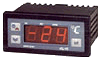
It's not uncommon for the Maxim-X to run hot (right into the red) on a hot summer day in stop & go traffic. Although the X is liquid cooled, it appears that Yamaha chose to have the cooling fan kick in at the very moment that operating temperature reached its maximum. It doesn't appear to be a problem, however, most Maxim-X owners would seem to prefer to have cooling begin a little sooner. I've heard from one Maxim-X owner who made some resistance changes of his own to cause the cooling fan to regularly engage a little sooner. I've heard from another Maxim-X owner in the Netherlands who installed a digital temperature control switch made by a company called Eliwell. Apparently it's necessary to fabricate something that makes it possible to measure engine temperature from the outside of a coolant pipe, but in the end, you can dial in any temperature you like to trigger the cooling fan. Most Maxim-X owners who are determined to change cooling fan operation will simply install a manual fan switch somewhere inconspicuous. If your Maxim-X runs too hot for your liking, you may want to try one of these methods of engaging the cooling fan... but long before that, you should verify that the fan is actually functional - they often aren't.

•    HI-FLOW NECESSARY
The Maxim-X generally runs pretty cool under normal operation. In fact, the gauge doesn't often reach "high noon" - regular operating temperature. That had me wondering whether or not to replace the original thermostat with a "regular flow" model rather than the "high flow" model it came with. However, as already mentioned, the engine can build up a lot of heat on hot summer days in stop & go traffic and on sustained high speed runs. A high flow thermostat seems to be absolutely necessary to improve cooling under those extreme circumstances. It's not recommended to replace the original part with a thermostat that has a smaller flow aperture.

•    GASKET UNAVAILABLE
When servicing the thermostat, it's absolutely imparitive that you keep the original rubber seal and treat it gently. The seal is a cross between a gasket and an o-ring in that it acts as a seal between the upper and lower halves of the thermostat housing but the seal has a groove on the inside perimeter which stretches over the edge of the thermostat. As yet, I haven't been able to source a suitable replacement and Yamaha doesn't sell the gasket alone. To get the gasket, you'd have to buy the entire thermostat assembly for about CAD$45 (Yamaha Part# 3GM-12410-00-00). Treat the rubber gasket kindly to spare yourself the grief of sourcing a new one.

•    MOTORAD - THE IRONY
One final, ironic observation - after searching high and low for a suitable alternative to the original Yamaha thermostat, I converged on a thermostat made by a company called Motorad. What's ironic is that the German word for motorcycle is Motorrad. Don't that beat all.